Through a detailed analysis of a comics page of your choice, critically evaluate one or two theoretical approaches to analysing comics. How useful are your chosen theorist(s) in helping us understand the comics page? Please include a screengrab or image of the comics page in your essay.
Introduction
This essay will explore Groensteen’s Spatio-Topia System Round’s theory of hyperrealism and further, Round’s application of Genette’s Narratology theory to the comic genre. A page will be used from Guardians of The Galaxy: Cosmic Avengers (2013) to evaluate both the flaws and benefits of these theories. The Application of named theories to the comic will be shown throughout the essay to aid the understanding of the comic. Lastly, it will evaluate their usefulness in understanding the comic genre as a whole.
The Spatio–Topia System
Comics simultaneously combine visual and discursive codes. They are often specified into symbolic categories (Groensteen, 2007). The closeness to Barthes's theory of Semiotics is apparent however Groensteen (2007) debates a better-articulated system of codes to understand the uniqueness of comic language. Therefore, according to Groensteen (2007), just examining semiotics in relation to comics hinders the ability to thoroughly comprehend comics as a whole due to the combination of visual and narrative aspects. Groensteen (2007) uses this rhetoric to propose their more detailed system, named the “Spatio–Topia System”.
Groensteen’s Spatio–Topia System is the analysis of panels regarding the following parameters:
1. “the form of the panel (rectangular, square, round, trapezoidal, etc.)
2. area, measurable in square centimetres.
3. The site of the panel concerns its location on the page and, beyond that, within the entire work.”
(p.31 Groensteen, 2007)
Using the Spatio–Topia System
Groensteen (2007) highlights through their system that the layout of a page can mirror the intended reaction of the audience. An example of this is when a horror comic designs itself so that all these parameters, area, site, and form, are aligned symmetrical, almost as a reflection. The reader will be confused by the unusuality. Such insightful observations may be overlooked if narrative and structural elements were combined, hindering the understanding of a comic, as attested by Groensteen (2007).
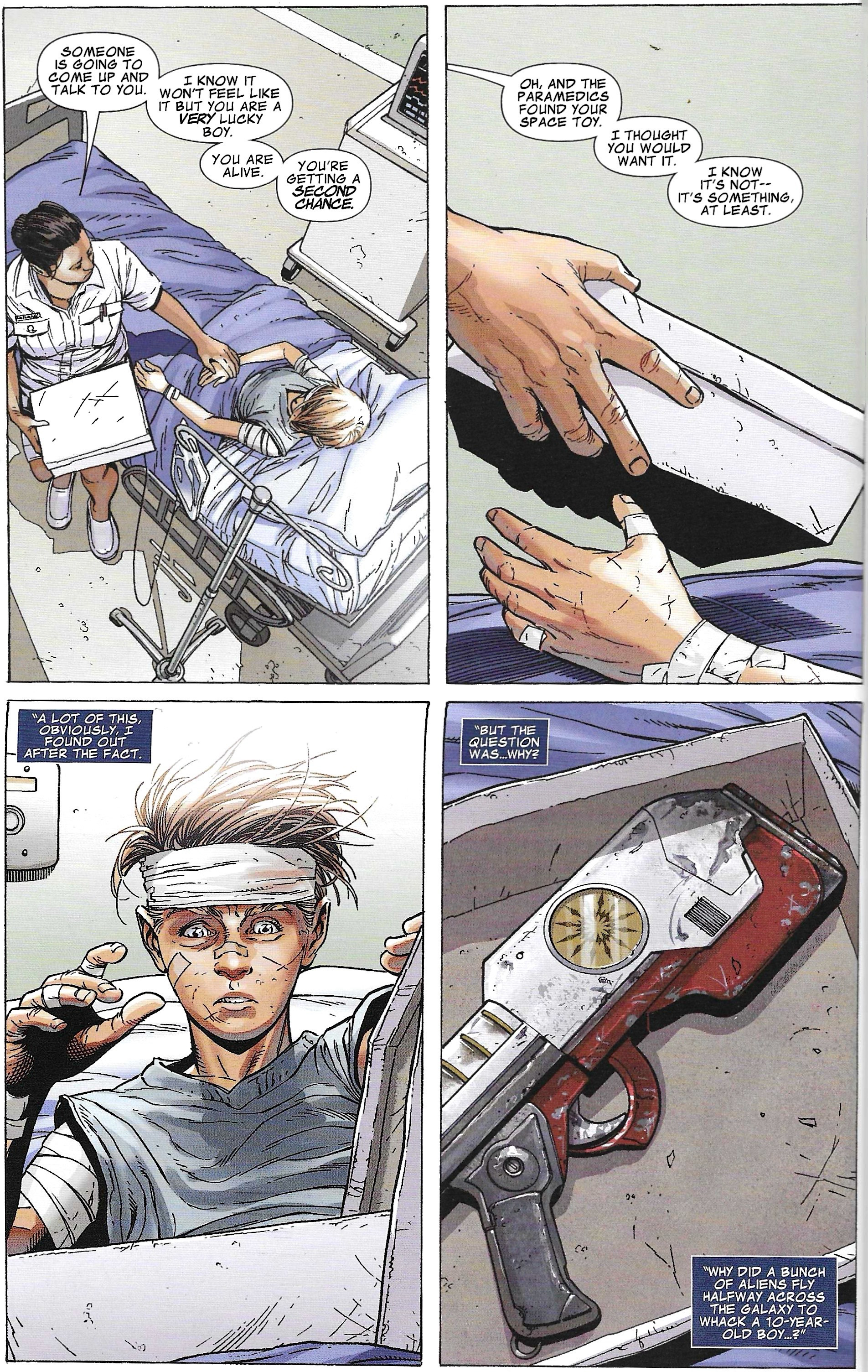
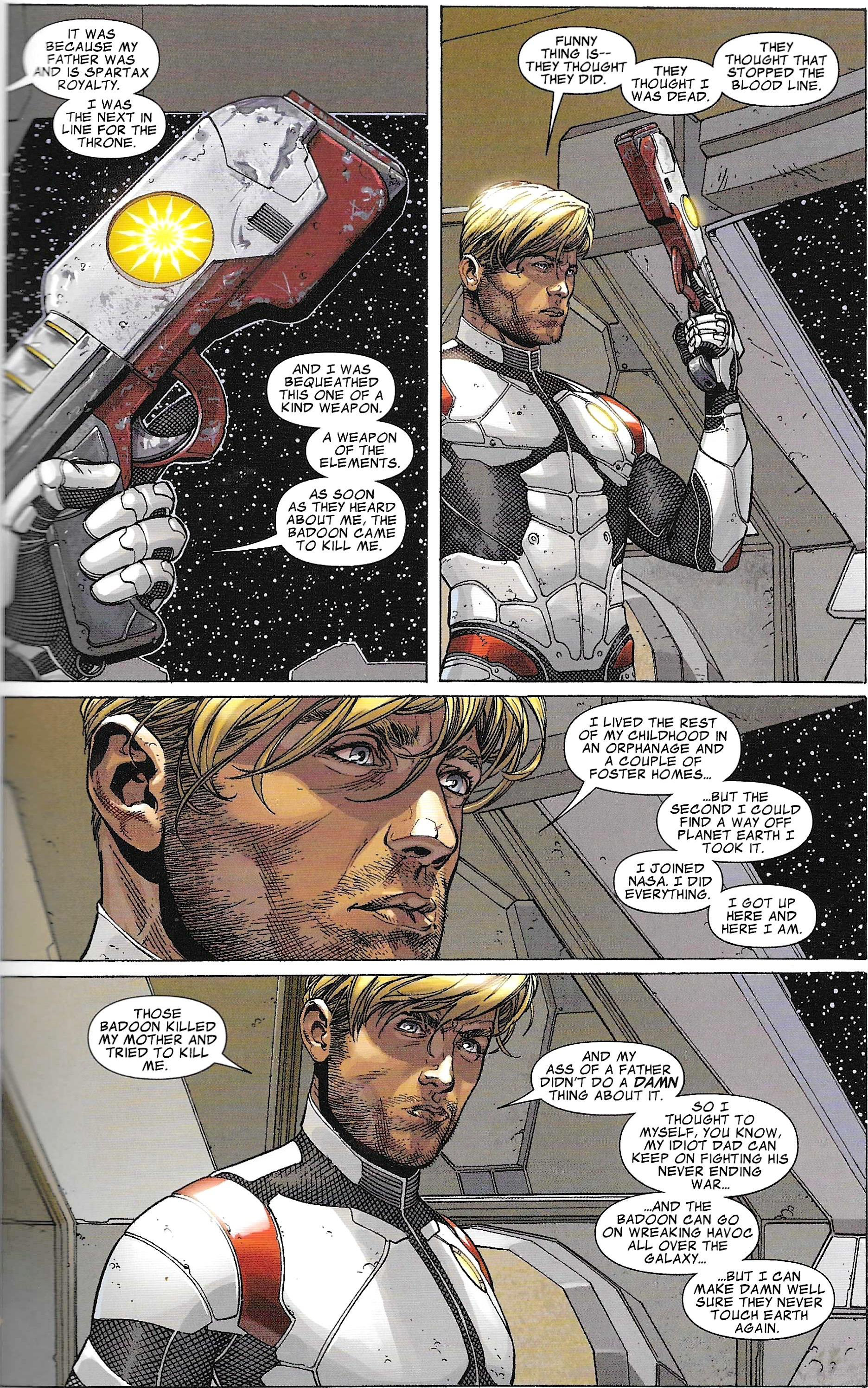
According to Groensteen (2007), Panels are just as important as the imagery itself. They represent space and time thus obeying the criteria that is visual as much as narrative. An example of this within Guardians of The Galaxy: Cosmic Avengers (2013) is when between the panels, a bigger margin is kept which allows for the change in time to be shown. The panels, moreover, maintain the same size, almost to get the audience to look at Peter Quill then and now. This is subtle but becomes obvious with the use of Groensteen’s system (2007).
The analysis of the form of the panel reveals that the gun is being handed over to Peter Quill in the top right panel. This mirrors the top left panel where Peter is shown picking up and displaying the gun. This not only indicates that the gun has a significant meaning in Peter's story as it is held at the forefront of the panel, but it also sheds light on his motivations for future missions.
It can be observed that the panels in the comic book have an equal and rectangular shape, except for the last two panels which have a longer rectangular shape. Though these elongated panels are of the same width as the previous panels, they are longer in length. The uniform width of the panels helps to maintain the flow of the story, without disrupting the emotions of the scene. The longer rectangular shape of the final two panels helps to highlight the emotions in Peter Quill's eyes as they are drawn like a close-up cinematography shot. It allows for him to recount the traumas of his childhood, without interrupting the narrative.
Lastly, The location of the final flashback page is placed near the end of the comic. The whole flashback takes place without any interruptions and is told in real-time through dialogue, it’s not till the end that the audience realises that Peter Quill is telling the story. It gives the audience a deeper look into the new character iteration whilst showing the trauma that Peter Quill has been through, alas creating an emotional connection to the audience. The second page of the spread shows the end of the handover of the gun which we see on the final page of the flashback. The gun is positioned at the end of Peter Quill's backstory retelling but at the beginning of the present-day showing Peter Quill's life now and representing the prominence of the gun in his life.
The Hyperreal
Round (2007) states, through the theory of hyperrealism, that the combination of the literal picture and the narrative input can contrast in meaning depending on the audience. Written techniques, such as making text stand out, alliteration and emphasis, and personal idealisms can, according to Round (2007), alter the connotation of the text.
Using Groensteen (2007) as a comparative, they highlight that panels solidify the importance of individual comic language on an audience. Panels are used to isolate separate entities that manipulate the meaning for the audience. Alas, the panels may appear singularly insignificant but can be integral to the narrative as a whole. Round (2007) neglects the panels as a separate entity entirety due to their postulation of hybrid signifiers, where multiple signifies interrelate to create a single unified symbol. Groensteen’s (2007) warning of homogenising codes can be substantiated here as it could be seen to forfeit understanding of the comic language.
Using Round’s theory of the hyperreal, the gun significance is placed in dialogue and empathised through repetition as Peter Quill states, “And I was bequeathed this one of a kind weapon” and within the next linked bubble “a weapon of the elements” (Peter Quill, Guardians of The Galaxy: Cosmic Avengers, 2013). This foreshadows the significance of the gun in the story’s future.
The importance of Peter Quill as a character in the story is highlighted through the use of boldened words. When the nurse comes to speak to Peter Quill, the words "lucky" and "second chance" are made to stand out as she says, “You are a very lucky boy" and continues to say, "You're getting a second chance" (Nurse, Guardians of The Galaxy: Cosmic Avengers, 2013). This emphasizes his motivations for being a Guardian of the Galaxy, a team formed to protect the galaxy, as the nurse's belief in him and her kindness makes his defence of Earth all the more personal. He goes on to deliver "I can make damn well sure they never touch Earth again." to solidify his feelings toward the planet that saved him and gave him that second chance (Peter Quill, Guardians of The Galaxy: Cosmic Avengers, 2013).
Another phrase where a word is made to stand is “And my ass of a father didn’t do a damn thing about it” (Peter Quill, Guardians of The Galaxy: Cosmic Avengers, 2013). This time, instead of having a motivational tone, it is latticed with anger at his father. It helps the audience to understand Peter’s disdain for his father and his rule alas foreshadowing future conflicts within the comic series and as to why Peter Quill will be determined to see his father’s downfall.
Narratology theory
Round (2007) employs Genette's theory of Narratology to analyse comics. Round argues that dialogue has become the primary form of spoken narrative within the comic genre. Round also points out that due to the lack of heterodiegetic and homodiegetic language forms, comics cannot be solely analysed using Genette's theory. The comic uses both heterodiegetic and homodiegetic language, albeit to a limited extent as Round suggested. However, recognizing the use of such language is crucial in understanding the spatial and temporal aspects of the comic.
The narration style used on this page is quite complex. The primary form of narration is dialogue, as Peter Quill narrates his story to Tony Stark. Towards the end of the first page, in the lower right and left panels, two dialogue boxes appear in blue with white text. These represent Peter Quill's past thoughts, as he narrates his story in the present tense. The purpose of this is to help the audience transition from the flashback to the present moment.
Conclusion
To conclude, Groensteen (2007) decides that Spatio – the Topia System allows for a better understanding of the comic language. He argues it better describes the intricacies of the visual and discursive codes whilst also preventing the consequential if merged, homogenising of said codes. It can be argued that Round’s (2007) homogenising of codes with their theory of hybrid signifiers and defining all comic elements as a “unified entity” to be analysed singularly (p. 317. Round, 2007) inhibits the ability to look more in-depth at the comic language. On the contrary, merely looking at panels, as Groensteen (2007) primarily does, as the main form of comic understanding and audience manipulation is reductive to comprehending the effect of comics as it does not encompass a more unorthodox analysis of comics. Round’s analysis of exterior influence on comic understanding, such as personal idealisms, and their application of narratology should not be undervalued in its benefit to comprehend the comic. Overall, the cohesive use of both theorists has allowed for a greater understanding of the comic page.
References
Bendis, BM., McNiven, S and Pichelli, S. 2013. Guardians of The Galaxy: Cosmic Avengers. Kent: Panini Publishing and Marvel.
Groensteen, T. 2007. System of Comics. Mississippi: University Press of Mississippi. Retrieved from http://ebookcentral.proquest.com/lib/bournemouth-ebooks/detail.action?docID=619195.
Round, J. 2007. Visual Perspective and Narrative Voice in Comics: Redefining Literary Terminology. International Journal of Comic Art. Volume 9, No 2. Retrieved from: https://brightspace.bournemouth.ac.uk//content/enforced/344260-TBC/Julia%20Round%202007%20article%20Redefining_lit_terminology_pdf.pdf?ou=344260
Achiched a 2.1