Introduction
This essay is going to analysis the denotation and connotation of the Davidoff Cool Water advertisement. There are several language elements that the piece uses to convey the message that advertisers want audiences to perceive.
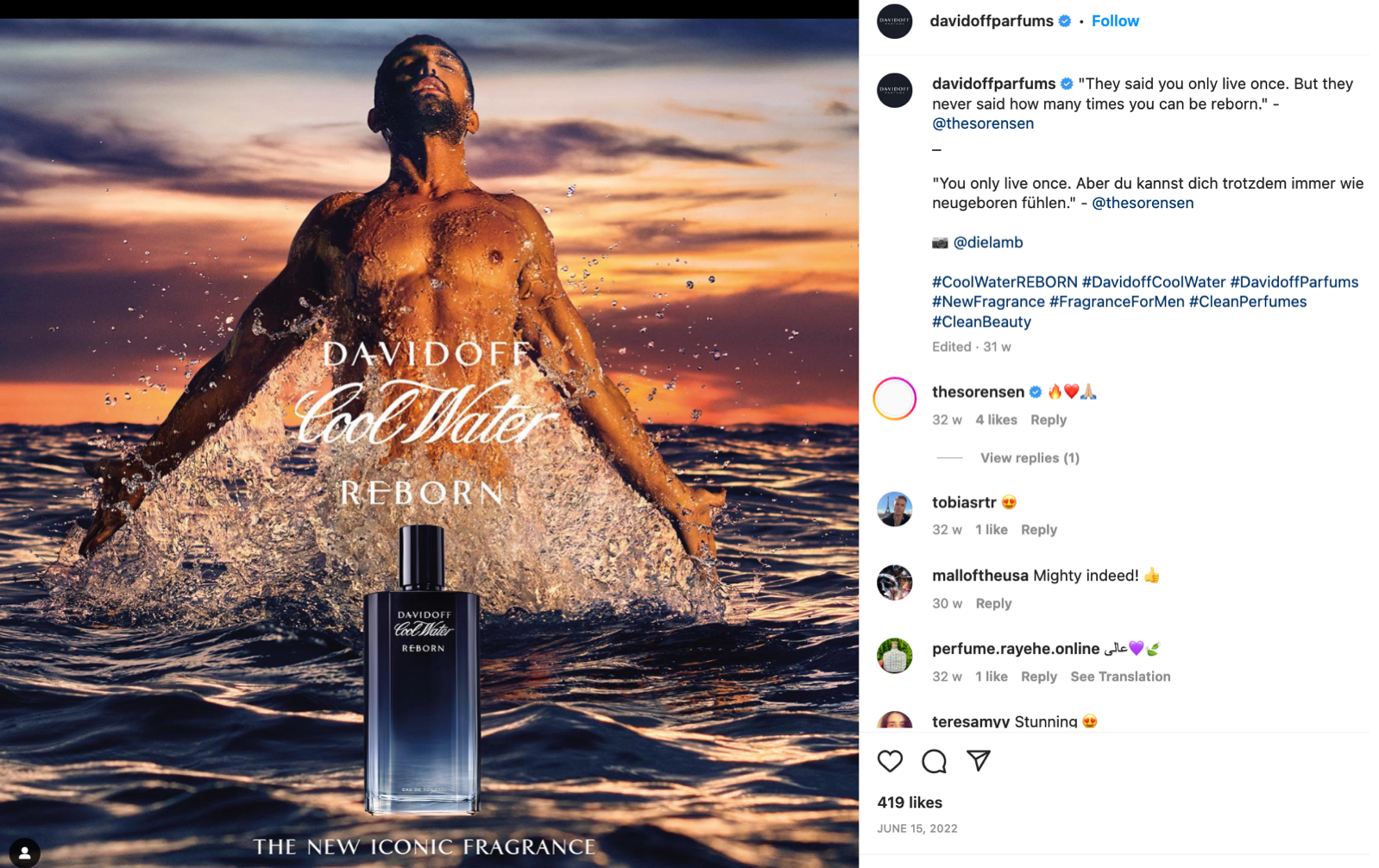
The modes of persuasion (Aristotle ca. 322 B.C.E/1998), Pathos, Ethos and Logos, are used to coerce consumers to buy the perfume. Pathos, demined the emotional element of the modes of persuasion, is used by the advertisement by using strong, ingroup language such as ‘you only live once’ which ultimately provokes a strong response, such as ‘mighty indeed’ by malloftheusa. Ethos, the aspect of credibility, is one that Davidoff orchestrates well within this piece. Through getting the man himself, who is portioned as a religious sort of entity, to comment and show his support, it creates a sense of truth to message that Davidoff are trying to transmit. Finally, Logos, the art of logic, is used again in the phrase, ‘you only live once’ stating a clear scientific fact. All these elements make up a persuasive piece, allowing audiences to fully immerse themselves in the advertisement.
Main Image
Signs, signifiers and the signified are the method of language analysis conjured by Saussure (1916), quoted here by Barthes (1964), as being “a general science of signs, or Semiology, of which linguistics would form only one part. Semiology therefore aims to take in any system of signs, whatever their substance and limits; images, gestures, musical sounds, objects, and the complex associations of all these.” Alas, Davidoff’s advert encompasses several messages, some which are obvious to the consumers, others that are more subtlety indicated.
Within the main image, the peace and serenity of the sunset background is disrupted by the juxtaposition of the man busting out from the water. It has connotations of disrupting the natural order, almost representing the splendour of the perfume. There is a sense of an unreal, almost religious, event when paired with the other signifiers such as the comment made by thesorenson in which they use the praying emoji, further adding to religious nature of the piece. Another notation is that of the use of a middle eastern man whilst speaking about being reborn. In Christian belief, monumental religious events took place in the middle eastern region. This exterior, contextual reference to such a well-known religion makes Davidoff appear to attempt to place themselves on the same sphere as that of a religious event. Ultimately, they show, through several signifiers, that they believe that perfume is ground-breaking and thus should be treated with the same level of estimation as that of religion.
Secondary, the use of a sunset is consequently a homage to cool water as water is cooler at night. This subtle reference is indistinctive of the intricacies of the signifiers used in the advert to make a whole coordinated piece. Barthes (1957) famous wine example, where he discussed how wine can be portrayed as either a bourgeoisie activity that makes one happy and inspires prosperity or an unhealthy and therefore damaging activity that can become uncivilised, depending on the positioning of the product. The motivation for differing contexts, he theorised, was predominately to sell products or to maintain a status quo. As an example, applying the same theory, cool water can be dangerous and can have ramifications of hypothermia whereas, here, being in cool water, is witnessed as manly and to be aspired to. The reason that Davidoff has done this is because they have adeptly named their perfume ‘cool water’ hence they want to make all connotations and associations positive.
Use of Colour
Colour is used extensively within this advertisement, whether purposefully or not. Colour have various connotations depending on the context in which it is used or the combination in which it is used. “Colour plays an undeniable and significant role in our quest for business success, happiness and health.” McLeod (2016) muses. In particular, in this case colour is used by Davidoff for “business success” in persuading consumers of their products benefits.
The colours used within the main image are mostly representative of elements. That of Christine Lichtlé (2015) states the literal denotation of colour, “Colours can symbolise elements (red and orange for fire, green for water), space (light blue represents the vertical dimension), or time and timelessness (black and white)". With that, we can discern that orange is used for the sunset, the colour typically used for such depictions and blue for the sea/water, again a factual, most commonly associated colour of water. Logos, (Aristotle ca. 322 B.C.E/1998), the aspect of logic, is used in the formation of colour within the main image to make their piece grounded, and ultimately, believable. Another colour that the main image used is white, which has symbolisms of purity and light which inserts with the general theme of the piece, being reborn and hopeful.
Colour used within the comments section is far vaster than that of the advertisement itself. The predominant use of language is that of emojis. McCulloch et al (2019) defines that “repetition is abundant in emoji sequences and is rare in speech or written text.” Within this advert interaction we see a purple heart used by perfume.reyehe.online with the combination of green leaves. The purple hue represents luxury and wealth, in which Davidoff potions itself as through their price and celebrity endorsement. The green leaves are to represent nature. Speaking to Glossy (2022), the adverts director highlights that men are, after the pandemic, looking to “reconnect with nature to reinvent themselves.” Hence the use of the leaf emoji shows that that message has reached audiences. With use of such emojis in conjunction with each other, they indirectly perpetrate Davidoff message of luxury and nature.
Positioning
In terms of the sociolect of the advertisement, we seen the piece translated in both English and German as well as being interacted with Arabic speaking users. The reason behind the German translation is because Davidoff is a German brand therefore, they want to remain faithful to their brands origin.
In terms of idiolect, we see that the brand is placed in the advertisement image itself and in the hashtags. That of Nadube et al (2018) empathises that “Organizations are…positioned relative to one another, mainly as a consequence of their corporate identities.” Therefore, use of such hashtags like ‘fragranceformen’ alines themselves with similar brands, reaching the appropriate consumers.
Hapax legomena of Davidoff is a made-up word that has inserted itself with the ideas of luxury even though the derivative word meant nothing. They have manged to create these connotations though only using their name on its produce and advertisements. Because the Davidoff word means nothing, they have been allowed to create whatever meaning that suits their agenda, true or not.
The Caption
The caption of this advertisements represents one of grandeur and importance. It connotates these values through stylistics, ingroup language and paralanguage. When observing the style in which the caption is written, The style of the wording physically is conjoined. This, therefore, connotates the appearance of luxury and wealth. The way in which it is written further indicts Davidoff’s attempt at making their perfume seem monumental.
When it comes to remarking on the use of paralanguage, the use of full stops and gaps within their caption create a sense of import to their message. Having breaks within their statements allows for the audience to focus on what is being said whilst also being representative of something significant being transmitted. Overall, this use of paralanguage has benefited the general brand identity of Davidoff, which is one of class and prominence.
Commenting on ingroup language, the caption including ‘You’ at the beginning of the powerful phrase, ‘you only live once’ is not only direct inclusion of the audience, but it also further adds a sense of importance and, almost, a sense of urgency to get the perfume as it reminds the audiences the impermanence of life. That of Jakobson (1960) muses “The imperative sentences cardinally differ from declarative sentences: the latter are, and the former are not liable to a truth test” and here, with such phrase as ‘you only live once”, Jakobson (1960) highlights that use of such ‘imperative’ phrases can be beneficial in advertisements as they are neither true or false, allowing advertisers to create whatever importance or grandeur around their product as they please.
The Comments
The mathematical theory of communication produced by that of Shannon and Weaver (1949) expresses the various stages of a message. The five stages are as follows: the information source, the transmitter, the channel, the receiver, and the eventual destination. Although the theory was originally concocted for radio producers, it has great importance in our understanding of communication. The predominate factor to look at here is that of the six elements, the disruptor. This can harm the intended meaning of the message thus hindering the supposed effect on audiences. In this case, the comments section of social media pieces is where the message can be altered. In this Davidoff example, we see predominantly men interacting with post due to it being a men’s perfume, but we see teresamvv, a woman, stating ‘stunning’ which therefore has denotations of lust and beauty, and, ultimately, female approval. Overall, In this example, the disruptor is helpful in perpetuating Davidoff image of manliness.
To Conclude
In conclusion to this analysis, the use of various denotations, and alas connotations, have propelled Davidoff’s advertisement into an intricate piece in which the message of mainlines, luxury and rebirth is at the centre. Using religious signs and signifiers, they have solidified their perfume into one of great importance in their target audience’s mind.
References
Aristotle, A.1998. Complete Works of Aristotle, Volume 2: The Revised Oxford Translation. J., Barnes, Trans. New Jersey, USA: Princeton University Press. Pp. 2125 – 2270
Barthes, R. 1964. Elements of Semiology. Hill and Wang [online]. 1. Pp. 1-18. Retrieved From: https://sites.evergreen.edu/arunchandra/wp-content/uploads/sites/395/2018/07/barthes.pdf
Chandler, D. 1994. The Transmission Model of Communication [online]. Thesis. University of Western Australia. Retrieved From: http://visual-memory.co.uk/daniel/Documents/short/trans.html
Glossy. 2006. Cool Water is Reborn [online]. Toronto, Canada. Retrieved from: http://glossyinc.com/2022/09/13/davidoff-cool-water-reborn/[Accessed 8th of March 2023]
Jakobson, R. 1960. Linguistics and Poetics. Style in Language [online]. Ed. Pp. 1-27. Retrieved from: https://pure.mpg.de/rest/items/item_2350615/component/file_2350614/content
Krippendorff, K. 2009. Mathematical Theory of Communication. Encyclopaedia of Communication Theory [online]. 1. Pp. 614-618. Retrieved from http://repository.upenn.edu/asc_papers/169
Nadube, P and James D. 2018. Market targeting and strategic positioning. ResearchGate [online]. 1. Pp. 32-45. Retrieved from: https://www.researchgate.net/profile/Paul-Nadube-2/publication/336773986_Market_targeting_and_strategic_positioning/links/5db1964692851c577eba7d24/Market-targeting-and-strategic-positioning.pdf
McCulloch, G and Gawne, L. 2019. Emoji Grammar as Beat Gestures. Lingthusiasm [online]. 1. Pp. 1-4. Retrieved from: https://ceur-ws.org/Vol-2130/short1.pdf
McLeod, J. 2016. Colour Psychology Today [online]. Winchester: John Hunt Publishing. Retrieved from: https://books.google.co.uk/books?hl=en&lr=&id=W-ydDQAAQBAJ&oi=fnd&pg=PT21&dq=colour+psychology&ots=310tSdnI6x&sig=bMwgY0cLpHMUJNvJLCaPitW-XhE&redir_esc=y#v=onepage&q=colour%20psychology&f=false
Archived a 2.1